+91-6261599182
 vyasastrologyinfo@gmail.com



 Feb-21-2026

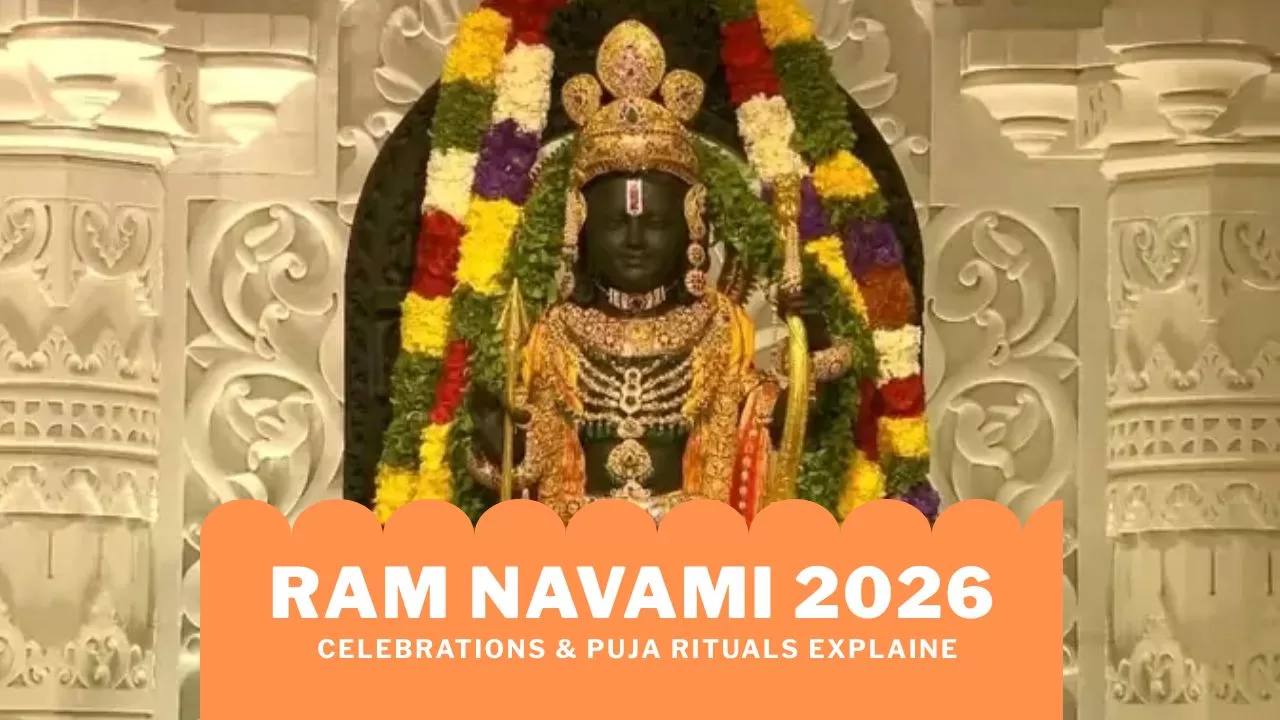
One of the most important Hindu festivals is Ram Navami which is observed with much sanctity and excitement throughout the entire Indian and Hindu societies worldwide. It also glorifies the birth of Lord Rama who is the seventh incarnation of Lord Vishnu a divine hero and his life is the model of dharma (righteousness) and courage, compassion and nobility. As per Hindu lunar calendar, Ram Navami will be observed on Thursday, 26 March 2026 in the year 2026 but the celebration and time may vary slightly according to the place one is.
What Is Ram Navami?
Ram Navami is a Hindu religious festival that glorifies the incarnation (avatar) of the Lord Rama on earth. Based on a conventional Hindu calendar it falls on the ninth day of a waxing week (Shukla Paksha) of the month of Chaitra, the first month of the Hindu lunar year.
Lord Rama is reported to be born in Ayodhya- one of the sacred cities of North India to the king, Dasharatha and to the queen, Kaushalya. His life story, which has been documented in the epic Ramayana, has had a cultural and spiritual impact as well as ethical thinking on the Indian cultural philosophy and spiritual thought throughout the centuries.
Date and Time of Ram Navami 2026
Ram Navami will be celebrated in the year 2026 on Thursday 26 March, 2026. The festival is celebrated on the 9th day of the lunar calendar (Paksha) known as Shukla Paksha in the Month of Chaitra according to the Hindu Panchang (lunar calendar). Calculation of the day is done in such a manner that Navami Tithi dominates on the midday (Madhyahna) since it is said that the time was when Lord Rama was literally born.
The special importance has been attached to the Madhyahna period since it is mentioned in scriptures that in this holy midday muhurat Lord Rama was born in Ayodhya. Therefore, the main puja, singing of the mantras, and aarti is fulfilled at this period of the year by the believers.
Timing Detailed Critical Specifics (IST).
Date: Thursday, 26 March 2026
Navami Tithi Begins: 11.48 AM, 26 March, 2026.
Navami Tithi Ends: 10:06 AM on 27 March 2026
Madhyahna Puja Muhurat (Good Time): 11:13 AM- 01:41 PM.
Birth Moment (Madhyahna Moment): 12.27 PM.
The Madhyahna is considered to be highly sacred and during this time people carry out the Puja of Ram Navami, Abhishek and Aarti in the majority of the homes and temples. The followers recite the Ram Raksha Stotra, read the scripts in the Ramayana, as well as worship and spiritually thrill at the divine birth of the Lord Rama.
The Spiritual Significance
Ram Navami is more than just a birthday celebration and at the very core, it is a profound spiritual festival that emphasizes eternal human values and cosmic principles.
Lord Rama - The Ideal Being
Lord Rama is argued as being the perfect man (Maryada Purushottam) - a person who was:
1. Truth and righteousness2. Family piety and reverence.
3. Compassionate and just leadership.
4. Courage without ego
5. Devotion to duty (dharma) even when there is suffering.
His story is striking the chords of millions of people as it was the life of struggle between evil and good and the victory of good.
Symbolism of Ram Navami
Birth of Divine Grace: The birth of Lord Rama is considered to be the incarnation of divine consciousness in the human world to bring about dharma.
Victory of Good over Evil: His life story goes to the end with the victory over Ravana - the triumph over arrogance and ignorance.
Light to the People: The values observed in his life are selflessness, obligation, faithfulness and benevolence, which can give an example of how a person should act as well as in society.
The festival, therefore, turns into something beyond jubilation, it is confirmation of moral existence, piety, and spiritual concentration.
Rituals and Practices in the traditional way
Ram Navami is celebrated by means of different rituals that are done in homes, temples, and societies. These include:
- Early Morning Rituals
Before the sun rises, devotees have a holy bath, which is usually thorough to purify the body and mind before getting into the festival. House and prayer tables are swept and adorned with flowers and lamps.
- Ram Navami Puja
The main ritual is to pray to Lord Rama - having an idol or picture of Rama or not having it, having Sita, Lakshmana, and Hanuman. Devotees present:
1. Fruits2. Tulsi leaves
3. Incense
4. Panchamrit (a sacred mixture)
5. Sweets and flowers
Mantras known as sacred like the Ram Raksha Stotra, Vishnu Sahasranama, and Shri Rama Ashtakam are recited.
- Fasting and Devotion
A lot of individuals have a fast, which can be:
1. Complete fast (no food)2. Partially fast (only fruits or sattvic food)
3. It is a sign of piety and self control.
- Ramayana Path (Recitation)
Devotees also repeat some parts of Ramayana and in particular: the Bala Kanda and Ayodhya Kanda- the narration of the birth and early life of Lord Rama. Temples and homes are full of devotional energy created by group readings, bhajans, and kirtans.
- Shobha Yatras
There is a vivid show of community devotion in most cities and towns where processions with the idol of Lord Rama are commissioned, accompanied by a chanting and devotional music.
- Charity and Community Feasts
On Ram Navami, many devotees engage in charitable acts, offering food, clothing, and financial contributions to the needy — reflecting Lord Ramas spirit of compassion and service.
- Ritual Closure
After evening prayers, the fast is normally broken by distributing prasad (blessed food) like panakam, kheer and other traditional foods.
Popular Foods on Ram Navami
Even though the main focus is on fasting, certain foods are cooked as offerings (naidedya) and prasad:
1. Panakam: This is a cool sweetened drink containing jaggery, water and spices.2. Kheer: Rice pudding which represents sweetness and prosperity.
3. Kosambari: This is a lentil-vegetable salad that means nourishment. Such things are initially presented to the god and distributed to family and the society.
Regional traditions and celebrations
Ram Navami is observed in India in the local spirit and tradition:
Ayodhya
As the birthplace of Lord Rama, Ayodhya is the location of the richest celebrations - rituals in temples and processions, as well as huge pilgrim groups. The city has a predominantly religious air that is dominated by traditional bells, chants and devotional music.
North India
The states of Uttar Pradesh, Bihar, and Rajasthan are more likely to have huge processions of Ram Sevaks. The societies hold mass prayer and Ramlila shows re-enacting the epic.
South India
There are special pujas and cultural events in the temples: Vedic chanting, talks about the life of Rama and feasts of the community celebrate the day.
Western and Eastern India
In Gujarat to Bengal, families call in the local priests to carry out the puja, recite the names of Jai Shri Ram, and end the day with feasts and their neighbors and friends.
The Modernity of Ram Navami
Ram Navami is still very applicable to contemporary times:
1. Cultural Identity: It strengthens the unity within a given community because of common prayers and celebrations.2. Ethical Leadership, Duty, and Compassion Lord Rama in life stories provides moral guidance on ethical leadership, duty and compassion.
3. Spiritual Renewal: The devotional activities of the day enable the believers to increase their relationship with the divine.
4.Social harmony: With the essence of seva (service) and goodwill, the spirit of charity and community participation is strengthened.
It is also a state holiday in most Indian states- and this speaks of how significant it is in cultural and civic life.
Conclusion: A Festival of Devotion and Dharma
The Ram Navami 2026 which is going to be celebrated on Thursday, 26 March is, by no means, an ordinary festival in the calendar, but rather a time of great spiritual importance and cultural harmony. Worshippers all over the globe young and old gather up to rejoice on the birth of Lord Rama and reaffirm ancient standards of righteousness, self control, valor and mercy.
It could be temple practices, fasting, reciting the scriptures, community meals or a time of introspection, Ram Navami is an opportunity to take time and consider the meaning of life and the way of dharma - with the help of the timeless light of Jai Shri Ram.
Talk to an Expert Astrologer Today - Get your Kundali reading, Vastu consultation, or personalized guidance.
Recent Posts
-
Aug/26/2026
नरली पूर्णिमा और श्रावण पूर्णिमा 2026 एक ही दिन: जानें तिथि, शुभ मुहूर्त, पूजा विधि और महत्व
-
Aug/25/2026
संकष्टी चतुर्थी और कजरी तीज 2026 एक ही दिन: जानें पूजा विधि, शुभ मुहूर्त, व्रत और महत्व
-
Aug/24/2026
रक्षाबंधन 2026: राखी बांधते समय भाई-बहन को किन बातों का ध्यान रखना चाहिए? जानें तीन गांठों का महत्व और मंत्र
-
Aug/22/2026
चंद्र ग्रहण और रक्षाबंधन 2026: क्या ग्रहण के दौरान राखी बांध सकते हैं? जानें ज्योतिषीय नियम
-
Aug/20/2026
Raksha Bandhan: रक्षाबंधन 2026 कब है? जानें 27 या 28 अगस्त में सही तारीख, भद्रा काल और राखी बांधने का शुभ समय
Appointment Booked!
Appointment booked successfully!
We will contact you shortly.
Book an Appointment