+91-6261599182
 vyasastrologyinfo@gmail.com




 Sep-16-2026

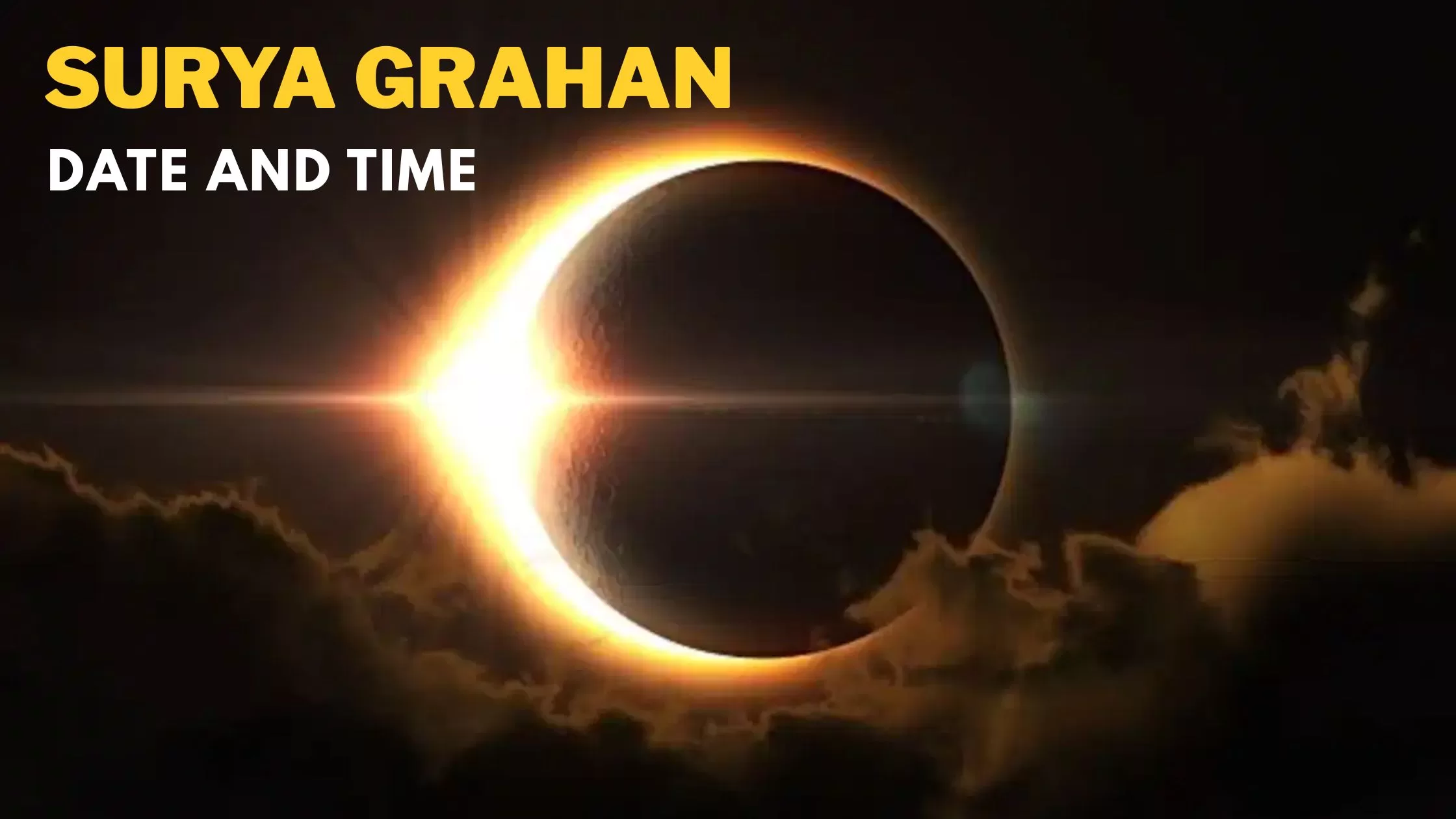
Surya Grahan, or Solar Eclipse, is one of the most fascinating astronomical events witnessed from Earth. It occurs when the Moon passes between the Earth and the Sun, partially or completely blocking the Sun’s light. Apart from its scientific importance, Surya Grahan holds deep spiritual, cultural, and astrological significance in India.
The year 2026 witnessed its first solar eclipse in February, and now the second and final solar eclipse of the year will occur on 12 August 2026. Interestingly, both eclipses will not be visible in India, yet they remain significant from an astronomical and astrological perspective. The first eclipse of 2026 will be an Annular Solar Eclipse, popularly known as the “Ring of Fire,” while the second will be a Total Solar Eclipse.
Let us explore the dates, timings, visibility, and astrological importance of Surya Grahan 2026 in detail.
When and Where
First Surya Grahan 2026 – Annular Solar Eclipse (Completed)
The first solar eclipse of 2026 occurred on 17 February 2026, on the occasion of Phalguna Amavasya (New Moon day). It was an Annular Solar Eclipse.
In an annular eclipse, the Moon does not completely cover the Sun because the Moon appears slightly smaller than the Sun from Earth. As a result, a bright ring of sunlight remains visible around the Moon, creating the stunning “Ring of Fire” effect.
Although this eclipse was not visible in India, it was observed in:
● Parts of Antarctica
● Southern regions of Africa
● Some areas of South America
Astronomy enthusiasts in these regions will be able to witness the annular phase, while India will not experience any visible impact.
Date and Time (First Surya Grahan 2026)
The timings of the first Surya Grahan, which occurred on 17 February 2026 (Tuesday), were as follows (IST):
● Start Time: 3:26 PM
● Maximum Eclipse: 5:52 PM
● End Time: 7:52 PM
Status: This eclipse has already occurred.
Even though the eclipse occurs during these hours, it will not be visible from India. Therefore, traditional restrictions like the Sutak period will not be applicable for people in India.
Visibility (First Surya Grahan 2026)
Since the eclipse will not be visible in India, there will be:
● No Sutak period
● No mandatory religious restrictions
● No need for temple closures
● No ritual fasting requirements
However, for those living in regions where the eclipse is visible, proper precautions must be followed while observing it.
Second Surya Grahan 2026 – Total Solar Eclipse
The second and final Surya Grahan of 2026 will occur on 12 August 2026 (Wednesday), during Shravan Krishna Paksha (Vikram Samvat 2083). This will be a Total Solar Eclipse (Khagras Surya Grahan).
In a total solar eclipse, the Moon completely blocks the Sun for a brief period, turning day into twilight. During totality, the Sun’s outer atmosphere, known as the corona, becomes visible - a rare and magnificent sight.
Visibility (Second Surya Grahan 2026)
The timings of the second eclipse (as per IST) are:
● Sparsh (Beginning): 9:04 PM
● Madhya (Maximum): 11:26 PM
● Moksha (End): 1:28 AM
This eclipse will also not be visible in India.
It will be visible in:
● North America
● Greenland
● Europe
● Northwestern parts of Africa
● Parts of the Atlantic Ocean
● Arctic region
Since it will not be visible in India, no Sutak period or religious restrictions will be observed in the country.
Horoscope Significance during This Surya Grahan 2026
In Vedic astrology, Surya Grahan is considered a powerful celestial event that can influence zodiac signs and planetary energies. Even if the eclipse is not visible in India, astrologers often believe it may still have subtle energetic effects.
Here are some general astrological interpretations:
Impact on Zodiac Signs
● Fire Signs (Aries, Leo, Sagittarius): May experience changes in career direction or personal goals.
● Earth Signs (Taurus, Virgo, Capricorn): Financial planning and stability may become a focus.
● Air Signs (Gemini, Libra, Aquarius): Communication and relationships may undergo transformation.
● Water Signs (Cancer, Scorpio, Pisces): Emotional introspection and spiritual growth may intensify.
Spiritual Significance
● A time for meditation and reflection
● Avoid starting major new ventures during eclipse hours
● Ideal for mantra chanting and self-analysis
● Let go of negative patterns
However, since both eclipses are not visible in India, their direct astrological intensity may be considered milder for Indian residents.
Precautions While Observing the Phenomenon
If you are in a location where the Surya Grahan 2026 is visible, observing safety measures is extremely important.
Eye Protection
● Never look directly at the Sun without certified eclipse glasses.
● Use ISO-approved solar viewing glasses.
● Avoid using sunglasses, X-ray films, or smoked glass.
Safe Viewing Methods
● Use solar filters on telescopes or binoculars.
● Try pinhole projection methods.
● Watch live streams provided by space agencies if you lack proper equipment.
What to Avoid
● Do not observe with naked eyes.
● Do not use unfiltered cameras or telescopes.
● Do not rely on homemade unsafe methods.
Solar radiation can permanently damage eyesight within seconds, so caution is crucial.
Conclusion
The Annular Solar Eclipse on 17 February 2026 has already concluded. The second and final solar eclipse of the year will occur on 12 August 2026.
For India, there will be no Sutak period or religious restrictions due to non-visibility. However, from a spiritual and astrological viewpoint, many people may still choose to observe meditation, prayer, or introspection during eclipse hours.
As the final solar eclipse of 2026 approaches, astronomy enthusiasts around the world look forward to witnessing this spectacular celestial event. Although it will not be visible in India, people in the visibility path can safely observe it using certified solar eclipse glasses.
अक्सर पूछे जाने वाले सवाल (FAQ)
No. Both the solar eclipses in 2026 - the Annular Solar Eclipse on 17 February 2026 and the Total Solar Eclipse on 12 August 2026 - are not visible in India. Therefore, no Sutak period or eclipse-related religious restrictions are applicable in the country.
The next and final Surya Grahan of 2026 will occur on 12 August 2026 (Wednesday). It will be a Total Solar Eclipse (Khagras Surya Grahan), but it will not be visible from India.
No. Since the 12 August 2026 Total Solar Eclipse will not be visible in India, Sutak Kaal will not be observed, and temples, religious activities, and daily routines can continue as usual.
The 12 August 2026 Total Solar Eclipse will be visible from parts of North America, Greenland, Europe, northwestern Africa, the Atlantic Ocean, and the Arctic region. It will not be visible anywhere in India.
If you are in a region where the eclipse is visible, always use ISO-certified solar eclipse glasses or approved solar filters for telescopes and binoculars. Never look directly at the Sun without proper eye protection, as it can cause permanent eye damage.
Talk to an Expert Astrologer Today - Get your Kundali reading, Vastu consultation, or personalized guidance.
Recent Posts
-
Sep/16/2026
Parivartini Ekadashi 2026: सितंबर में परिवर्तिनी एकादशी कब है? जानें सही तारीख, पारण समय, पूजा विधि, व्रत कथा और महत्व
-
Sep/15/2026
Vishwakarma Puja 2026: विश्वकर्मा पूजा कब है? जानें शुभ मुहूर्त, पूजा विधि, मंत्र और महत्व
-
Sep/14/2026
Santan Saptami 2026: संतान सप्तमी 2026 व्रत कब है? जानिए शुभ मुहूर्त, पूजा विधि, व्रत कथा और व्रत का महत्व
-
Sep/11/2026
Ganesh Chaturthi 2026: गणेश चतुर्थी 2026 कब है? जानें पूजा का शुभ समय, पूजा विधि और विसर्जन तिथि
-
Sep/10/2026
Hartalika Teej 2026: हरतालिका तीज कब है? जानें तारीख, शुभ मुहूर्त और पूजा विधि
Appointment Booked!
Appointment booked successfully!
We will contact you shortly.
Book an Appointment